From the Pages
Recipes
The dishes that defined the legends. Cook history.

Susan Mullally Weil, 1984.
Boston College Archives
Maya Angelou · 1928–2014
Spaghetti Caruso
A beloved dish of one of America's most celebrated poets and storytellers.
Ingredients
Serves 3–4, can be easily doubled
- —½ cup flour
- —3 tablespoons good olive oil
- —1 large garlic clove, freshly crushed
- —1 large yellow onion, finely diced
- —1½ cups dry red wine that you'd like to drink
- —2 cups sliced portobello mushrooms
- —1 pound chicken livers, rinsed (If you can find yellow chicken livers as opposed to the port-wine-colored ones, they will be sweeter and less bitter than the red ones.)
- —1 anchovy, packed in oil, smashed
- —1 28-ounce can San Marzano tomato sauce or a can of whole San Marzanos squeezed by hand
- —1 8-ounce can tomato paste
- —¾ teaspoon seasoned salt
- —1 bay leaf
- —1 teaspoon ground pepper
- —⅛ teaspoon ground nutmeg
- —1 teaspoon sugar
- —1 pound spaghetti, uncooked
- —1 heaping tablespoon capers, drained
- —1 cup grated Parmesan-Reggiano (Add the rind to the sauce while it cooks for even more flavor!)
- —Additional Parmesan-Reggiano or Pecorino Romano at the table
Method
Put 1 tablespoon of the olive oil into a nonstick skillet. Remove all fat from the livers and slice into desirable pieces for your preference. Dredge the livers in the flour and sauté over medium-high heat until firm and brown. Put into a bowl and set aside.
Add remaining olive oil to skillet and drop in the onions. Sauté on medium heat until translucent. Add the mushrooms, as well as the garlic. Sauté on medium until the mushrooms release their juices.
Turn heat up to medium high and add the wine, stirring to reduce by about half. Add the anchovy (an umami flavor bomb), tomatoes, and tomato paste. Stir in the seasoned salt, bay leaf, pepper, nutmeg, and sugar.
Reduce heat to medium low and simmer for about 40 minutes. Add ¼ cup of the Parmesan-Reggiano at 10-minute intervals to get it well incorporated into the sauce.
Boil pasta according to directions, using copiously salted water — should taste like the ocean. Drain and plate with Caruso sauce. Garnish with parsley and capers and serve additional Parmesan-Reggiano at the table.
Buonissimo!
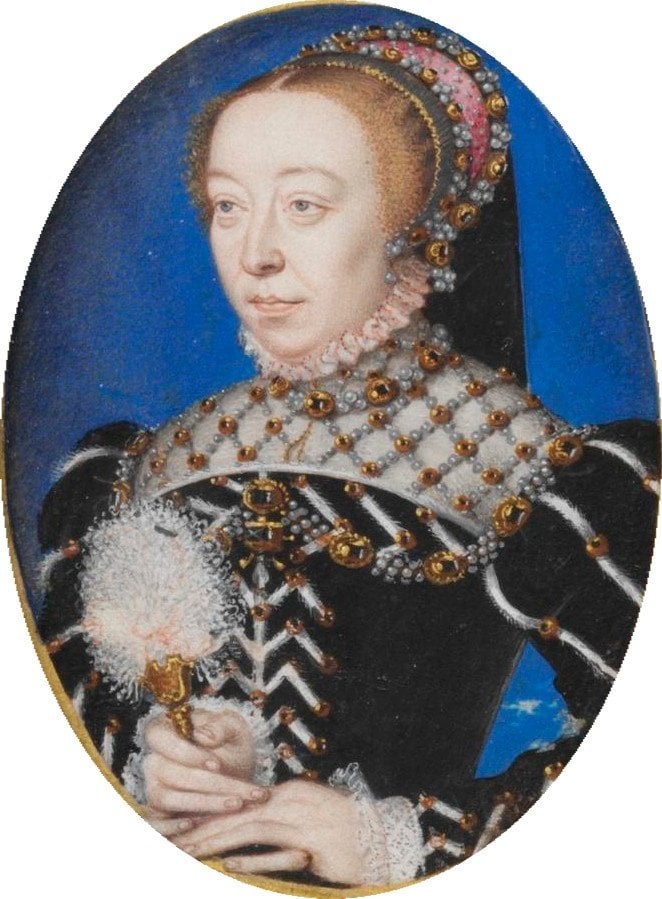
François Clouet, 1555.
Wikimedia Commons
Catherine de' Medici · 1519–1589
Duck à L'Orange
A crown jewel of the French Renaissance table — rich, bright, and fit for a queen.
Ingredients for the Bird
Serves 4
- —1 duck, fresh or thawed (about 5 pounds)
- —5 tablespoons butter or ghee
- —1 tablespoon vegetable oil
- —5 oranges (Cut in half and squeeze, saving the juice in two portions, and set aside for the roasting liquid and sauce. Save the halves for stuffing inside the bird.)
- —1 large sweet yellow onion, cut into quarters
- —1 carrot, cut in half
- —1 celery stalk, cut in half
- —2 garlic cloves, smashed
- —3 sprigs of thyme
- —1 tablespoon kosher salt
- —½ teaspoon Chinese five-spice powder
- —1 teaspoon cumin
- —1 teaspoon coriander
- —1½ teaspoons black pepper
- —1 cup chicken stock
- —1 cup white wine (Choose whatever kind you want to drink with the duck!)
Ingredients for Sauce L'Orange
- —Roasting pan juices
- —2 tablespoons cornstarch dissolved in 2 tablespoons water
- —1 tablespoon butter or ghee
- —Reserved orange juice
- —4 tablespoons sugar
- —1 teaspoon salt
- —½ cup Grand Marnier (optional but highly recommended)
- —2 tablespoons white wine vinegar or sherry vinegar
Method
Preheat oven to 450°. Pat the bird very dry and discard gizzards and other parts. Take the orange halves, quartered onion, carrot and celery pieces, garlic, and thyme and place inside the cavity. Rub smashed garlic all over the skin. Mix all dry spices together and generously rub all over the duck. Prick duck carcass all over with a fork. This will help to release some of the fat and crisp up the skin.
Put the duck in the oven and roast for 30 minutes on the lower center rack. Then reduce the heat to 350°, and in a small bowl, combine the stock, wine, and half of the orange juice and add to the roasting pan around the bird. Roast for 1 to 1½ hours (depending on the size of the duck) until the thigh meat reaches 170°.
Turn on the broiler and carefully broil the duck until its skin turns a lovely medium-golden brown and starts to crisp up. Remove to a carving board and let it rest for 15–20 minutes.
Meanwhile, remove as much clear fat as possible from the bird juices in the roasting pan. Pour the remaining roasting liquid into a nonstick skillet and add the cornstarch-water mixture. Stir over medium-low heat with a whisk to incorporate. The cornstarch mixture will give body and creaminess to the sauce.
Add the remaining ingredients and stir until reduced by half. Taste as you go, adjusting the seasoning to your liking. I prefer using a bit more Chinese five-spice powder since the flavor profile of this recipe is deep and rich. With a pastry brush, lightly brush warm sauce over the skin of the bird. Pour remaining sauce into a gravy boat to serve alongside the duck. Carve with a sharp knife and raise a toast to the bright light of the French Renaissance!
Suggested sides are a delicious green salad, asparagus, or roasted sheet-pan veggies. A baguette served with salted French butter would complement the feast. A sparkling dry Riesling or Viognier would be delightful as well.

Metro-Goldwyn-Mayer, 1941.
Wikipedia
Katharine Hepburn · 1907–2003
Katharine Hepburn's Brownies
Simple, rich, and legendary — just like the woman herself.
Ingredients
- —½ cup unsweetened cocoa, or two squares of unsweetened baker's chocolate (2 ounces)
- —1 stick (½ cup) unsalted butter, room temperature
- —1 cup sugar
- —2 eggs
- —¼ cup flour
- —½ teaspoon vanilla
- —¼ teaspoon salt
- —1 cup nutmeats, like pecans or walnuts, optional
Method
Grease an 8-inch-by-8-inch pan. Preheat oven to 325°.
Melt the butter over low heat in a medium saucepan together with the cocoa or the chocolate. Whisk until smooth.
Remove from the heat and stir in the sugar, vanilla, and eggs. When well mixed, stir in the flour and the nuts. Pour into the greased baking pan and smooth out.
Bake for about 35–40 minutes or until a toothpick inserted in the middle comes out clean. Let cool and then slice into squares with a sharp knife.
Pour a cold glass of milk and enjoy.
Source: Liz Smith, "Katharine Hepburn's Brownies," Ladies' Home Journal, 8/1975, VOL. XCII, No. 8.